
Flooding is a significant concern in the Upper Midwest (Illinois, Indiana, Iowa, Michigan, Minnesota, and Wisconsin).
Between 2020 and 2024, the region experienced more than a dozen flood-related major disaster declarations. The resulting financial impacts have been substantial, with over $1 billion in FEMA Individual Assistance, nearly $120 million in Public Assistance for damaged infrastructure, and almost $20 million in hazard mitigation funding.
State emergency management agencies are responsible for developing state-specific emergency plans, conducting training and exercises, and managing state-level disaster response resources. When a disaster strikes, they oversee the immediate response to the disaster and coordinate disaster response and recovery efforts with local jurisdictions within the state. Additionally, state emergency management agencies advise governors on whether to request a Presidential Disaster Declaration based on assessments of the disaster’s severity and the state’s capacity to respond.
If pursuing a Presidential Disaster Declaration is necessary, the governor of the affected state must make a formal request. The Federal Emergency Management Agency (FEMA) — the organization that coordinates disaster response and recovery efforts nationwide — then conducts a preliminary damage assessment to evaluate the extent of the disaster, its impact on individuals and public facilities, and the type of federal assistance needed. If the disaster’s impact is deemed to be beyond the state’s capabilities, the president can declare a disaster, enabling the state to apply for federal assistance. FEMA advises the president on the issuance of Presidential Disaster Declarations based on assessments of the disaster’s impact and the need for federal assistance. Once a declaration is made, FEMA provides financial and logistical support to state and local governments during federally declared disasters and emergencies and administers federal funding to facilitate those efforts.
Communities have funding program options when it comes to disaster recovery. They also have funding options to pay for disaster preparedness and protection. Generally speaking, the disaster recovery funds require a Presidential Disaster Declaration while the preparedness and protection programs do not.
Reduction and Readiness Funding Programs
Reduction and readiness funding programs do not require a Presidential Disaster Declaration. Their primary objectives are to identify and analyze long-term risks to human life and property from hazards — and to develop plans, policies, and procedures to mitigate risk and respond to emergencies.
- Building Resilient Infrastructure and Communities (BRIC): The BRIC program was cancelled in 2025 and restarted in 2026 following a federal court order. Since its restart, BRIC has been significantly narrowed from earlier funding cycles, making applications more intensive and, in practice, more challenging for small communities to compete. Prior to cancellation, BRIC applications could support planning, capability building, technical assistance, phased project development, and some early‑stage or innovative concepts. Under the current program, applications are focused almost entirely on construction‑ready hazard mitigation infrastructure, with clearly defined scopes, completed or near‑completed design, and strong benefit‑cost analyses — conditions that often require substantial up‑front investment and technical capacity. Competitive projects include floodwalls, major stormwater conveyance systems, flood control infrastructure along urban waterways, protection or relocation of flood‑vulnerable public facilities, and drainage improvements that address repetitive flooding. While FEMA’s BRIC deadline is in late July, states establish earlier notice‑of‑intent or pre‑application deadlines — often in late spring — to allow time for review and prioritization.
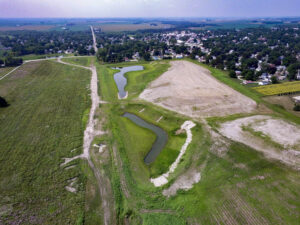
- Flood Mitigation Assistance (FMA): FMA aims to reduce or eliminate the risk of repetitive flood damage to structures insured by the National Flood Insurance Program (NFIP). Eligible projects include flood control, acquisition and demolition of flood-prone structures, and elevating or reconstructing structures to be hazard-resistant.
FEMA mitigation funding programs generally require that projects be included in a FEMA‑approved and locally adopted hazard mitigation plan at the time of application. Communities without a current, approved plan are typically ineligible for mitigation funding, making plan adoption and maintenance a foundational step in pursuing flood mitigation grants.
Response and Recovery Funding Programs
Response and recovery funding programs do require a Presidential Disaster Declaration. Their primary objectives are to take action immediately before, during, or directly after an emergency to save lives, protect property, and help communities recover — and to coordinate efforts and processes to bring about the immediate, medium-term, and long-term regeneration of a community following an emergency.
- Hazard Mitigation Grant Program (HMGP): HMGP provides funds to reduce disaster losses and help communities recover from emergencies. Funds are available in areas with a Presidential Disaster Declaration and a locally adopted hazard mitigation plan. Projects can include retrofitting buildings, purchasing hazard-prone property, and improving infrastructure.
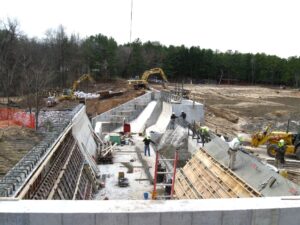
Construction of a new dam after a massive flooding event in Lake Delton, Wisconsin.
- FEMA Public Assistance Program (PA): The PA program provides funds to state, tribal, territorial, and local governments and eligible private non-profit organizations to respond to and recover from major emergencies or natural disasters. Projects are categorized as Emergency (e.g., debris removal, emergency protective measures) or Permanent (e.g., reconstruction of infrastructure, public buildings, utilities).
Program Applications and Requirements
States, tribes, and U.S. territories may apply directly to FEMA for funding. Private property owners, local governments, and non-profit organizations must apply through their state or territory. FEMA funding programs are reimbursement grants, so recipients must first incur costs and then submit them for reimbursement. Accurate and thorough record-keeping is essential to ensure maximum reimbursement.
Grant recipients must maintain detailed records of all expenses incurred during disaster response and recovery. This includes time records for staff, contracted labor, and volunteers — documenting hours worked, activities performed, and hourly rates, including benefits. Additionally, it is crucial to keep comprehensive records of equipment used with detailed descriptions, activities, dates, and hours of use. Materials consumed should also be meticulously documented, including purchase prices, quantities, locations, and purposes of use. By maintaining such detailed records, grant recipients can facilitate the reimbursement process and ensure that all eligible expenses are accounted for.
By understanding and utilizing these programs, communities can better prepare for, respond to, and recover from flooding events, ensuring a more resilient future.
Authors

Diane Rowe, MPA, AICP, ICMA-CM
Senior Community Development Administrator
Contact Diane Rowe, MPA, AICP, ICMA-CM