
Wisconsin Act 173, also known as the Truth in Planning law, changes how cities and villages plan for housing through comprehensive plans and how communities handle rezoning requests for housing projects.
The goal of this legislation is to help communities meet growing housing needs while keeping development consistent with local plans. The practical effect of these requirements is that comprehensive plans will now function as more concrete guides for future development rather than general policy documents. Municipalities that approach implementation proactively will be better positioned to comply with the statute while advancing local planning and development objectives.
The importance of Act 173 centers on two areas regarding how communities review, regulate, and approve housing projects, as outlined below. This act also increases the housing extension currently available for certain Tax Incremental Districts (TIDs) at the end of their lifespan, from one to two years.
Residential Density in Planning and Codes
This act requires cities and villages to update the land use elements of their comprehensive plans to identify where residential development is expected over the next 20 years, broken into 5‑year periods, as well as specify minimum and maximum net residential density for those areas. If a community (specifically, city or village) adopts or amends zoning or subdivision ordinances, those ordinances must be consistent with the comprehensive plan and include the residential net density standards.
“Streamlining” Rezones
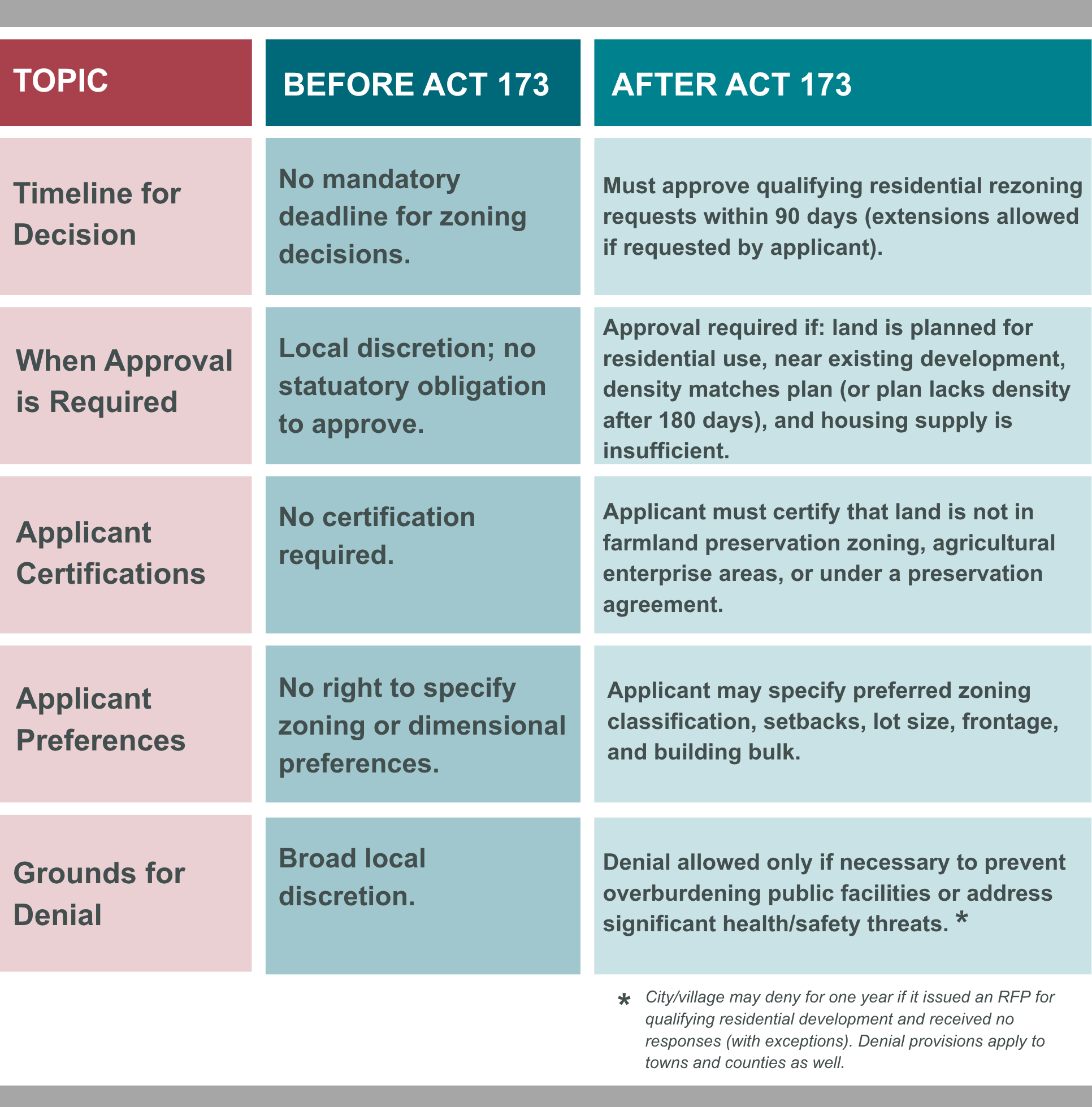
This act requires cities and villages to automatically grant rezoning requests for residential housing developments within 90 days, provided that the proposed development meets certain predefined conditions, as defined below. The applicant may request an extension on the 90-day deadline. Applicants may also specify preferences for zoning classification and dimensional standards (setbacks, lot size, etc.).
If these conditions are true, rezones shall be automatically approved:
- The land is identified for residential use in the comprehensive plan.
- The land is adjacent to or near existing development.
- The proposed net density is within the plan’s density range. If the municipality’s comprehensive plan lacks density standards, the community has 180 days from the rezone request to incorporate them in the plan; otherwise, this condition is met. Amendments solely to add net density in response to a zoning change request do not need to follow the usual comprehensive planning procedures.
- The current housing supply does not meet existing or forecasted 5‑year demand (as stated in the plan).
- The applicant certifies the land is not in farmland preservation zoning, agricultural enterprise area, or under a farmland preservation agreement.
Denial of rezones is allowed only if the community shows it is necessary to prevent shortages or overburdening of public facilities, or to address a significant threat to public health or safety. A community may also deny a zoning change or permit for one year if:
- it issues a request for proposals for a qualifying residential development with a density matching the plan, and
- no one responds, subject to certain exceptions.
The applicant may seek relief through an action for mandamus and may recover court costs, including reasonable attorney fees, if the community fails to approve the zoning change within the 90-day deadline (or extension date if requested).
Next Steps
Wisconsin Act 173 takes effect on January 1, 2028. MSA encourages local governments to begin planning efforts early in advance of the statutory deadline. Doing so will allow municipalities to create defensible, data-informed plans and address any needed comprehensive plan and zoning updates through a deliberate and orderly process.
Questions? We’re here to help. Reach out directly to Steve Tremlett at stremlett@msa-ps.com for more information about how MSA can support your changing needs.

Author