
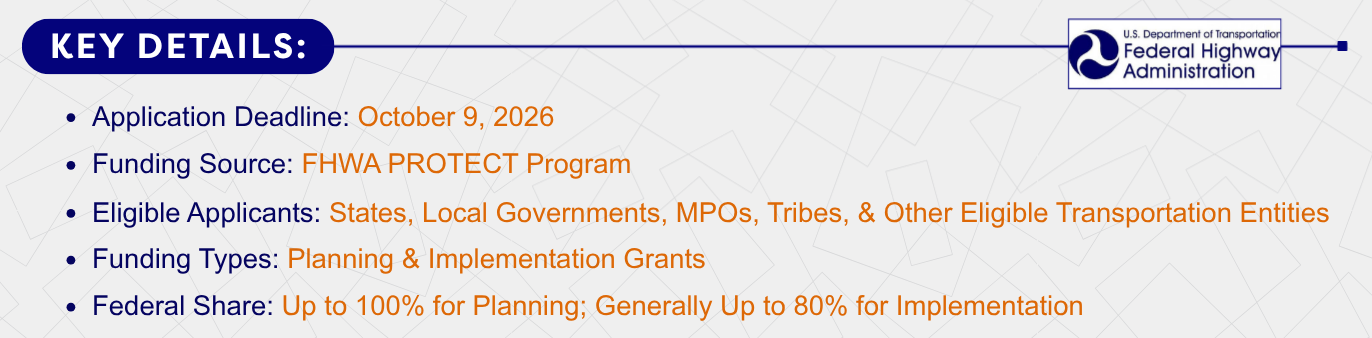
Transportation agencies and local governments have a significant opportunity to secure federal funding for infrastructure resilience projects through the Federal Highway Administration’s (FHWA) Promoting Resilient Operations for Transformative, Efficient, and Cost-Saving Transportation (PROTECT) Program. The program supports both planning efforts and implementation projects designed to reduce the impacts of flooding, severe storms, extreme temperatures, and other natural hazards on transportation systems.
The PROTECT Program was created through the Bipartisan Infrastructure Law (BIL) to help communities improve the resilience of transportation infrastructure to flooding, severe storms, wildfires, extreme temperatures, and other natural hazards. The program supports both planning and implementation projects that strengthen the ability of transportation systems to withstand and recover from disruptive events.
Following changes in federal administration priorities, the program experienced delays and uncertainty and is now effectively playing catch-up. The FHWA has combined FY2024, FY2025, and FY2026 funding into a single solicitation and is working to award and obligate remaining Bipartisan Infrastructure Law funding. As a result, communities should view this as a significant funding opportunity and should not assume there will be another PROTECT funding cycle in the future.
Similar to what we’re currently seeing in other federal funding programs, the revised program places a strong emphasis on project readiness. While construction projects do not technically need to be shovel-ready, applicants should assume that projects with completed planning, advanced engineering, clear cost estimates, identified local match, and documented resilience benefits will be significantly more competitive.

The current solicitation includes four funding categories designed to support communities at different stages of resilience planning and implementation.
Funding Categories
1. Planning Grants: $77M available; up to 100% federal funding
-
- Vulnerability Assessments
- Resilience Planning
- Evacuation Planning
- Development of Resilience Improvement Plans (RIPs)
- Transportation Resilience Studies & Analyses
Recent Award Examples:
- Monroe County Highway Department (Wisconsin) $506K: Assessed vulnerabilities of bridges, culverts, dams, and roadways; prioritized future improvements; and identified strategies to reduce impacts from flash flooding and extreme weather across a watershed.
- Champaign County Regional Planning Commission (Illinois) $380K: Evaluated transportation infrastructure vulnerability to severe weather and climate impacts throughout the county transportation system.
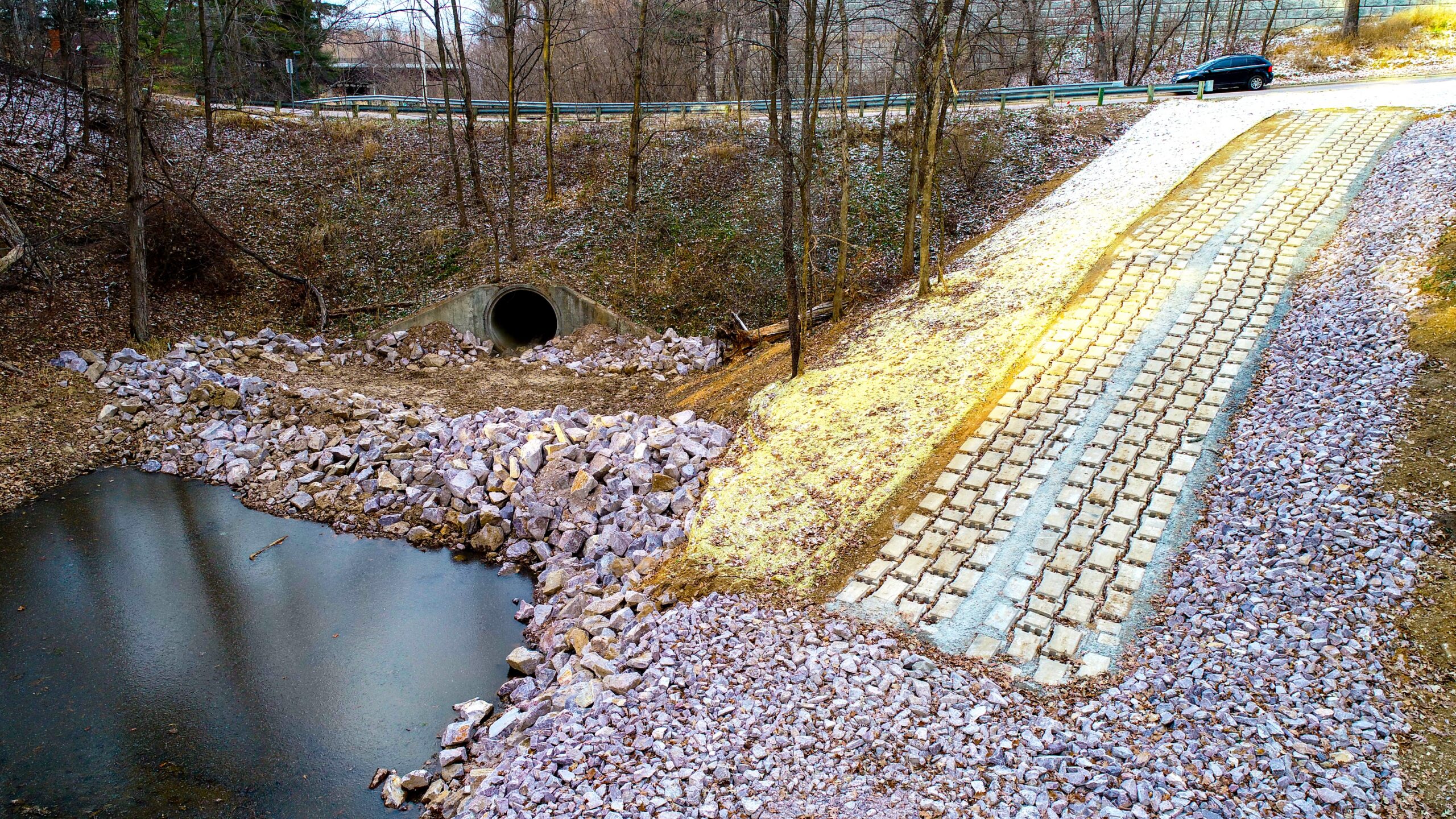
2. Resilience Improvement Grants: $537M available; up to 80% federal funding
-
- Roadway Elevation
- Bridge Improvements
- Drainage & Culvert Upgrades
- Stormwater Management
- Slope Stabilization
- Nature-Based Resilience Solutions
Recent Award Examples:
- City of Davenport (Iowa) $13M: Raised and reconstructed roadways vulnerable to Mississippi River flooding and improved access to major river crossings.
- Florida Department of Transportation $18M: Elevated roadway segments, improved drainage infrastructure, and added pump stations to address chronic flooding and sea level rise.
3. Community Resilience & Evacuation Route Grants: $77M available; up to 80% federal funding
-
- Improve Evacuation Routes
- Enhance Emergency Access
- Add Transportation Redundancy
- Improve Mobility During Disasters
Recent Award Examples:
- Mississippi Department of Transportation $4.8M: Improved hurricane evacuation routes through contraflow operations, signage improvements, gates, and traffic management upgrades.
- County of Missoula (Montana) $2.9M: Replaced a critical bridge serving 7,000 residents and functioning as an important evacuation route during wildfire and flood emergencies.

4. At-Risk Coastal Infrastructure Grants: $56M available; up to 80% federal funding
These grants support infrastructure threatened by:
-
- Coastal Erosion
- Storm Surge
- Sea Level Rise
- Great Lakes Shoreline Impacts
Recent Award Examples:
- Sarasota County (Florida) $6M: Strengthened a critical evacuation route serving nearly 3,000 residents and thousands of visitors.
- New Hampshire Department of Transportation $20M: Reconstructed coastal protection measures to reduce impacts from erosion, coastal storms, and sea level rise.
Resilience Improvement Plans (RIPs)
RIPs provide communities with a structured approach to understanding and addressing transportation vulnerabilities — and can be an invaluable tool when applying for PROTECT Program implementation funding (categories 2-4 above) or grants from other sources. While Planning Grants (category 1 above) can be utilized specifically to develop RIPs, communities that compile them proactively will be better positioned to pursue funding by having already identified transportation assets that may be vulnerable to flooding, severe storms, erosion, and other hazards.
RIPs can help communities prioritize infrastructure investments, support capital improvement planning, strengthen emergency response and evacuation strategies, and better coordinate transportation investments with hazard mitigation and asset management efforts.
Should You Pursue Planning or Implementation-Focused Funding?
Planning Grants support planning activities such as vulnerability assessments, resilience/evacuation planning, and Resilience Improvement Plans. The remaining PROTECT funding categories primarily support the implementation of transportation resilience improvement projects.
Given the extremely short application window, communities without a well-developed transportation resilience project may be more competitive pursuing a Planning Grant.
While the PROTECT program does fund construction and implementation projects, pursuing those grants is a significant undertaking. Construction applications require documented vulnerabilities, defined project scopes, reliable cost estimates, benefit-cost justification, environmental review considerations, and a clear path toward implementation. The most competitive implementation projects have advanced planning and engineering completed, address documented transportation risks, demonstrate measurable benefits, have committed local funding, and are ready to move toward construction.
The Bottom Line
Communities with construction-ready resilience projects should strongly consider pursuing implementation funding through the PROTECT Program. Communities that are earlier in the process may be better positioned for a Planning Grant, which can fund vulnerability assessments and Resilience Improvement Plans at up to 100% federal cost.
With a consolidated federal solicitation and a limited application window, now is the time to evaluate project readiness and determine the most competitive path forward.
Author

Diane Rowe, MPA, AICP, ICMA-CM
Senior Community Development Administrator