
East 7th Street Reconstruction
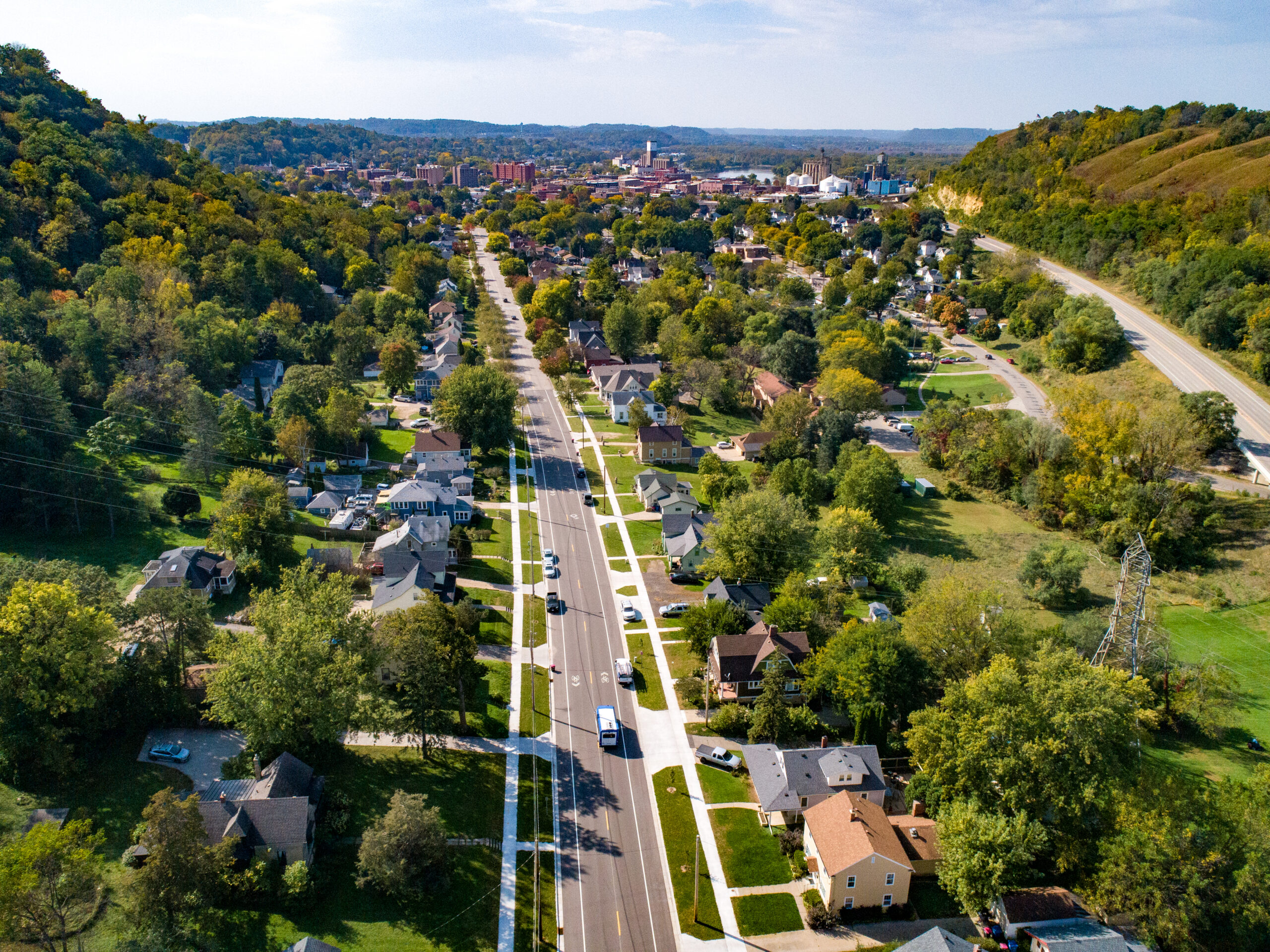
East 7th Street is one of Red Wing’s most important connectors — linking the historic downtown to U.S. Highway 61 and serving the homes, parks, and neighborhoods that define the city’s east side. When City leaders set out to reconstruct this one‑mile corridor, they sought a partner who could balance infrastructure needs with the community’s vision for safer, more welcoming multimodal transportation. MSA was honored to help bring that vision forward.
From the outset, the project posed both challenges and opportunities. East 7th Street is a high‑volume two‑lane roadway with sidewalks and on‑street parking throughout much of its length, leaving little room to introduce new bicycle or pedestrian amenities without thoughtful design. The City’s Complete Streets policy provided a meaningful framework but also required creative evaluation of multimodal options that could serve a changing corridor.
MSA’s engineering and planning teams worked side by side to explore four distinct design concepts — each integrating either on‑street bicycle lanes or a multiuse side path paired with existing sidewalks. To help community members visualize what these concepts could look like, the team produced edited photos and graphic cross‑sections. A letter and survey were shared with all adjacent property owners, creating a clear, accessible path for residents to weigh in on potential sidewalk or trail adjustments near their homes.

The public response shaped the direction of the project. Survey results and neighborhood feedback ultimately guided the City and project team toward on‑street bicycle facilities, ensuring the final design respected both user safety and local preferences.
With design direction established, MSA advanced the corridor through MnDOT’s Delegated Contract Process, supporting a project funded through a blend of state, federal, and local sources. The work included sanitary sewer, stormwater and water system upgrades; ADA‑compliant improvements; and the design of new Rectangular Rapid Flashing Beacons (RRFBs) to enhance pedestrian safety at key crossings. Portions of the corridor adjacent to a public park required a more rigorous environmental review, for which MSA prepared the Project Memorandum to meet all State Aid requirements.
Beyond technical expertise, the project showcased MSA’s experience navigating multi‑agency coordination — City, County, and MnDOT — and advancing a multimodal corridor that serves both everyday travel and recreational access to destinations like Colvill and Memorial Parks and Barn Bluff.
Completed in 2024, the $5.6-million project delivers Red Wing with a safer, more accessible transportation corridor that reflects the values of its residents and supports the community for decades to come. It is a testament to what can be achieved when engineering rigor, thoughtful planning, and authentic engagement all move forward together.
Client
City of Red Wing
Location
Red Wing, MN
Services Provided
Aerial Solutions
Bridges, Roads & Highways
Intersections & Roundabouts
Municipal Infrastructure
Planning & Economic Development
Surveying
Contact Project Lead

James Watters, PE
Transportation Team Leader
Related Projects
Ugstad Road & Arrowhead Road Improvements
Boosting pedestrian safety and vehicular efficiency along a busy mixed-use corridor.
More11th Street Safety Improvements
The City of Hudson selected MSA for a key roadway safety improvement project to address poor pavement conditions and improve pedestrian safety along 11th Street from Coulee Road to Wisconsin Street. The project utilized STP-Urban funding and involved WisDOT as a third party.

This project incorporated the full WisDOT process, including producing items such as a categorical exclusion checklist (CEC), pavement design report (PDR), and design study report (DSR). The project design included an alternatives analysis phase which developed a proposed typical section along the corridor to enhance both pedestrian and bicycle safety and promote safer driving speeds due to the proximity of the corridor to adjacent schools.

MSA collaborated with the City of Hudson and the public to evaluate multiple corridor traffic-calming alternatives and ultimately settled on a road diet with the addition of a shared-use path along the west side of the project. Noteworthy aspects of the project include its adjacency to a 4(f) resource, avoidance of right-of-way impacts due to a compressed design schedule, incorporation of a water main replacement, significant construction staging, and ADA design details. Construction was complete in 2025.
More