
West 5th Street Bridge Design
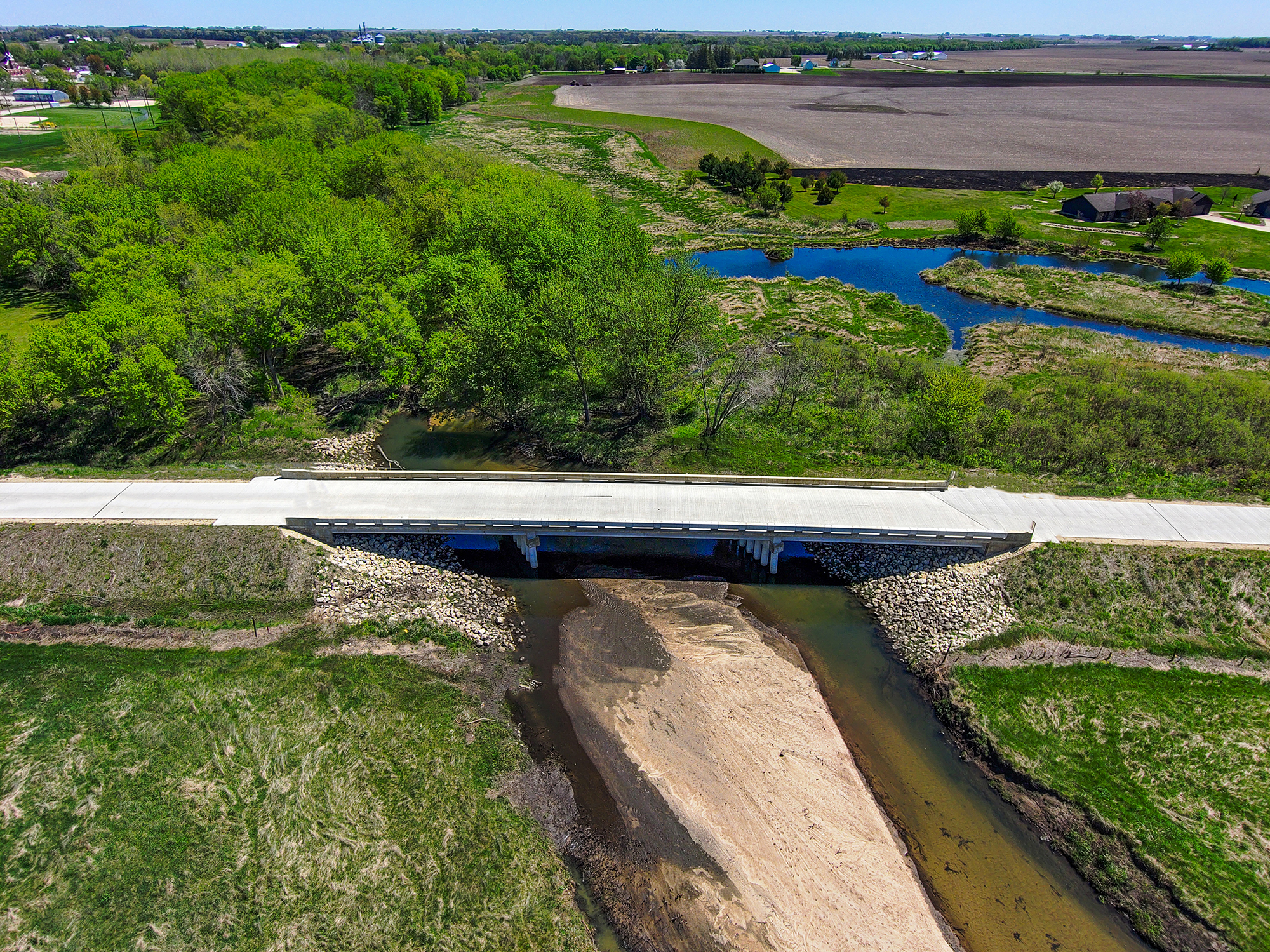
The West 5th Street Bridge, positioned over a small stream in Sumner, Iowa, has been fully redesigned and reconstructed to meet modern safety and traffic standards. Originally built in 1955, the previous structure — a 64-foot-long by 28-foot, 11-inch-wide continuous timber stringer bridge — was structurally deficient and restricted by a 10-ton posted weight limit, creating challenges for local traffic, particularly with an elementary school and school bus barn nearby.

The new bridge is an 80-foot-long by 30-foot-wide continuous concrete slab structure, featuring two 6-foot sidewalks and custom railings added via project addendum. This design enhances pedestrian safety, improves traffic efficiency, and elevates the aesthetic appeal of the corridor. The project was funded through the Iowa DOT’s City Bridge Program, reinforcing the state’s commitment to infrastructure modernization.
MSA provided comprehensive engineering services, including:
- Field Data Collection: Hydraulic conditions, structure geometry, site topography, and wetland boundary delineation.
- Design Development: Hydraulic modeling for alternative concepts, including a 1-span PPCB bridge and a 3-span CCS bridge.
- Permitting: Preparation of applications for the Iowa DNR and U.S. Army Corps of Engineers.
- Final Plans: Roadway improvements and structure plans for a CCS bridge with integral abutments and open pile bent piers, including sidewalks and custom railings.
- Roadway Improvements: Urban typical sections with storm and sanitary sewer replacements, curb and gutter, sidewalks, curb ramps, and reconstructed approaches.
- Property & Utility Coordination: Preparation of plats for acquisition and coordination with utilities.
- Public Engagement: Hosting a public information meeting to share concepts and gather feedback.
- Bid Preparation: Submission of final plans, specifications, and estimates for bid letting.
This project delivers a safe, efficient, and visually appealing crossing that meets current standards and supports the community’s transportation needs for decades to come.

Client
City of Sumner
Location
Sumner, IA
Services Provided
Contact Project Lead

James Watters, PE
Transportation Team Leader
Related Projects
7th Street Bridge over the Cedar River
In 2019, MSA partnered with the City of Janesville to replace the existing 7th Street Green Bridge, a three-span steel truss bridge with steel beam approach spans over the Cedar River. Originally constructed in 1930, the bridge was in a state of disrepair with restrictive vertical and lateral clearances and a posted 10-ton weight limit. It was time for a replacement — a project of great size and complexity.
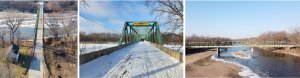
Former three-span bridge over the Cedar River.
Janesville straddles both Bremer and Black Hawk counties, with 7th Street serving as a key connection route between communities. The bridge accommodates an average of 1,800 vehicles per day and is surrounded by a mixture of residential, industrial, and rural agricultural property, with the east end of the bridge located less than 300 feet from the intersection with Main Street. After experiencing years of age and inspection concerns, the DOT and City agreed it was time to replace the bridge with something slightly longer, wider, and safer — without the restrictive overhead structure of the prior bridge design.
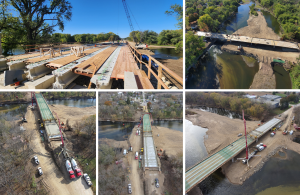
During construction of the new five-span bridge.
MSA bridge engineers designed a 501-foot-long, 30-foot-wide, five-span pre-tensioned prestressed concrete beam bridge supported on cap and column piers with drilled shafts founded in bedrock. Approximately 300 feet of existing roadway approaches were replaced as well, and the resulting structure has no posted weight limit, which is an immense improvement for the many heavy vehicles and large agricultural equipment that prefer to utilize this route.
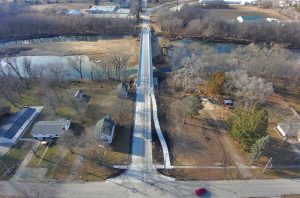
The project also includes street lighting, storm sewer installation, a separated 6-foot-wide pedestrian/bicycle path on the bridge, and construction of a new 8-foot-wide recreational trail on the north side that connects to an existing sidewalk along Main Street. To accommodate this work, extensive coordination with private utilities was required to relocate utilities in conflict. Additional right of way was acquired from adjacent landowners to construct project improvements.
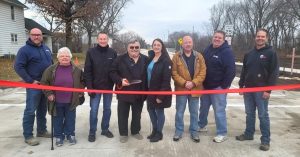
Construction began in January of 2023 and was completed in December 2023, allowing the DOT to utilize this stretch of 7th Street as an emergency detour route for upcoming construction work on IA 218.
The City of Janesville and project partners celebrated the grand re-opening of the bridge on December 15, 2023, with a ribbon-cutting ceremony and parade across the new structure led by local police and fire personnel.
More
South Division Street Bridge Replacement
MSA provided comprehensive engineering services for the replacement of the South Division Street Bridge over the Little Wapsipinicon River in Iowa. The original structure, built in 1956, was a 152-foot, three-span multiple steel I-beam superstructure supported by timber-backed abutments and timber piles. Classified as being in “poor” condition, the bridge required a full replacement to ensure safety and reliability for the traveling public.
 The new bridge is a 188-foot, 10-inch, three-span pretensioned prestressed concrete beam (PPCB) structure featuring an open concrete railing and a widened 24-foot, 6-inch deck to improve traffic flow and safety. It is supported by integral abutments with pile bent piers, anchored on driven steel piling and encased in concrete, ensuring long-term stability and structural integrity.
MSA’s role extended beyond design, encompassing a full suite of services, including:
- Field Data Collection: Hydraulic conditions, structure geometry, and site topography.
- Public Involvement: Engaging stakeholders and the community throughout the process.
- Agency Coordination: Working closely with the Iowa Department of Natural Resources and the U.S. Army Corps of Engineers and preparing permit applications.
- Utility Coordination: Meeting and coordinating with utilities for their relocation.
- Public Engagement: Hosting a public information meeting to share concepts and gather feedback.
- Final Plans: Roadway approach and structure plans for a PPCB bridge.
- Bid Preparation: Submission of final plans, specifications, and estimates for bid letting.
- Construction Oversight & Material Testing: Ensuring quality and compliance during every phase.
Partially funded through the Iowa DOT’s City Bridge Program, this project delivers enhanced safety, improved aesthetics, and greater traffic efficiency, while reflecting a commitment to sustainable infrastructure development. MSA’s comprehensive approach assured a successful bridge replacement that meets modern standards and serves the community for decades to come.
